




 $ADI
What happened
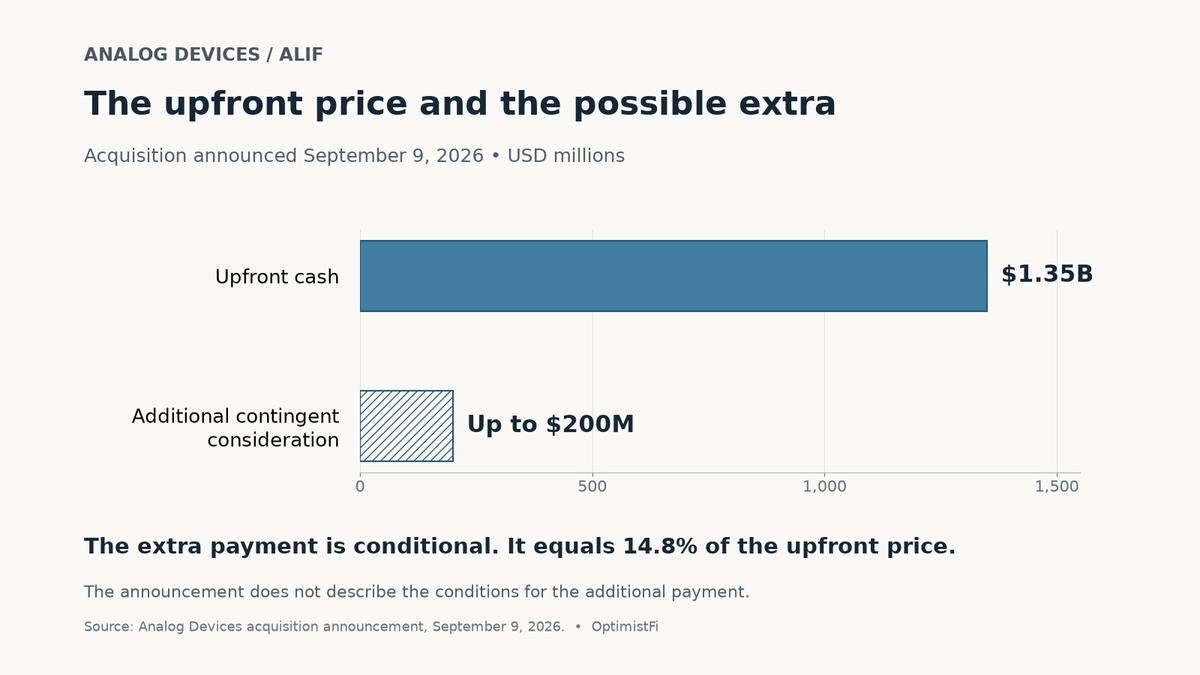
Analog Devices could pay an extra $200 million for Alif Semiconductor on top of its agreed upfront price.
The September 9 agreement calls for $1.35 billion in cash upfront, with the additional payment contingent on conditions. The announcement does not spell those conditions out.
The maximum extra payment equals 14.8% of the upfront price. Investors should keep the two amounts separate when assessing what Analog Devices has committed to pay.
Alif makes chips that process artificial intelligence inside devices. Analog Devices plans to combine that computing capability with its sensing, power and signal-processing products.
Why it matters
The upfront price is substantial relative to the cash the business generates. It equals 27.3% of Analog Devices' $4.937 billion in free cash flow over the twelve months ended August 1.
That company-defined measure subtracts capital spending from operating cash flow. It does not subtract acquisitions, dividends or share repurchases.
Analog Devices returned $5.170 billion through dividends and buybacks over the same period, already more than that free cash flow. Historical cash generation therefore is not an untouched acquisition budget.
This comparison does not establish a funding shortfall. Cash reserves, financing and future capital-allocation choices also matter. It shows why the purchase deserves scrutiny alongside shareholder returns.
The strongest argument for the deal is commercial fit. According to the companies, Alif already ships production chips and has consumer and industrial design wins.
Combining its processors with Analog Devices' existing products could let customers buy more of a complete system from one supplier. That is a plausible route to additional sales.
But the announcement provides no Alif revenue figure or earnings contribution. Existing shipments support the technology's commercial relevance without proving the acquisition price will earn an attractive return.
What's next
Analog Devices expects closing before the end of 2026, subject to regulatory and other conditions. The purchase is still pending.
Watch for the contingent-payment terms, Alif's financial contribution and evidence that customers adopt the combined products. The investment case strengthens if those sales generate cash after integration costs.